

Institutional AI Is Innovation.
Assistive AI Is Cheating.
How institutions automate our judgment while punishing us for automating the barriers to being judged
“Who gets authority over AI-mediated participation?”
This essay is part of the HIIT for AI™ body of work on relational intelligence as infrastructure.
A person submits a grant application.
On one side of the desk sits the applicant. She has done the research — the questions, the evidence, the rulings, months of nonlinear thinking that loops, doubles back, connects things no committee asked her to connect. Now the portal wants 2,000 characters of linear prose. For a neurotypical applicant, that translation is an afternoon. For an applicant with ADHD, the thinking and the flattening of the thinking are two different tasks, and the second costs disproportionately more than the first. So she asks her AI collaborator to do the flattening. The ideas are hers. The evidence is hers. The structure gets help.
On the other side of the desk sits the funder. Its software will triage the application, summarize it, score it, rank it, screen it for fraud — and, increasingly, flag whether the prose itself was AI-assisted. No one asks whether the funder really read her application. No one wonders aloud if the funder is lazy.
One of these uses is called efficiency.
The other is called cheating.
AI is legitimate when institutions use it to process people. It becomes suspect when people use it to survive institutions.
That asymmetry is the essay.
I am writing it in a specific week — August 10–12, 2026, when Anthropic confirmed it watermarks Claude’s text and a pre-release Gmail integration for the Pangram detector surfaced two days later. Section IV carries the dates and the hedges. But the week is the evidence, not the thesis: the asymmetry was true before watermarking existed. Watermarking just made it enforceable.
I. The Institution Gets to Automate
Institutional AI is increasingly normalized as infrastructure. Recruitment platforms screen applicants before a human ever sees a name. Ranking systems order the candidate pool. Automated interviews assess “suitability.” Fraud and plagiarism detectors scan what arrives. Inside professional organizations, productivity AI drafts the memos that judge your memo.
The scale has been documented for years. In 2021, Harvard Business School’s Project on Managing the Future of Work and Accenture published Hidden Workers: Untapped Talent — a two-year study of 8,720 workers and 2,275 executives across the US, UK, and Germany. Their estimate: more than 27 million people in the United States alone are “hidden workers” — qualified, actively seeking work, screened out before a human ever reviews their application. Eighty-eight percent of executives acknowledged that qualified high-skilled candidates were filtered out for not matching the exact criteria in the job description; for middle-skilled candidates, 94 percent. Read that again. The employers themselves admit the machine rejects qualified people. The machine stays. The people the funnel drops have names in the report: caregivers, veterans, people without college degrees, people with disabilities — anyone whose life does not produce the signals the software was configured to recognize.
That was the historical baseline. In 2026, we got the deployed-systems evidence. Bommasani, Bana, Creel, Jurafsky, and Liang’s Algorithmic Monocultures in Hiring (FAccT 2026) analyzed 4.2 million real applications from 3.4 million applicants across 156 employers — every one screened by algorithms from a single vendor. Measured the way US employment law requires, position by position under Title VII’s four-fifths rule, 25.87 percent of applications submitted by Black applicants and 14.74 percent submitted by Asian applicants went to positions showing adverse impact against those groups — disparities invisible in the vendor’s aggregate data, because aggregation is where disaggregated harm goes to disappear. And then the finding this essay needs most: systemic rejection. Ten percent of applicants who submitted four applications were rejected from all four — significantly above what statistically independent decisions would produce, a pattern absent in comparable hiring data without a centralized algorithm. When institutions delegate judgment to the same vendor, an applicant stops getting independent chances. She gets one judgment, repeated.
So: 2021 told us automated funnels systematically hide qualified workers. 2026 tells us deployed hiring AI reproduces racial disadvantage and correlated rejection across otherwise independent employers. The exclusion is not one detector behaving badly. It is architecture.
I have my own small version. Earlier this year, an immigration-services evaluation firm declined to advance my research profile — five publicly deposited outputs with DOIs — citing, in a template response, a lack of peer-reviewed publications. Whatever evaluated me, it was not a reader. It was a selection logic.
To be fair, audit and disclosure regimes exist on paper — Title VII disparate-impact doctrine, NYC Local Law 144, the EU AI Act’s high-risk classification of hiring systems. But the person being evaluated has little visibility into the institution’s automation, no choice in it, almost no ability to contest it. Her own automation, meanwhile, must be confessed.
Why is automated institutional judgment presumed legitimate while AI-assisted individual participation requires justification?
II. The Disabled Person Gets Called Lazy
Underneath the new technology sits an old moral category.
ADHD executive dysfunction has a familiar set of translations: difficulty initiating becomes laziness; difficulty sequencing becomes lack of discipline; hyperfocus that ends without a finished artifact becomes inability to finish. The cognition is real; the production pipeline is where it fails; and the culture reads the pipeline failure as a character verdict.
Then a technology arrives that reduces precisely those barriers — structure on demand, formulation support, an executive-function scaffold that holds the shape of the argument while you move through it — and the culture’s response is immediate:
You didn’t really do it.
Notice what happened. The barrier was the proof of sincerity. Remove the barrier with assistance, and the removal itself becomes the evidence against you.
We have built this move before and, mostly, learned to be ashamed of it. Dictation is an accommodation; so are screen readers, spellcheck, transcription, executive-function coaching, AAC devices. I am not claiming AI collaboration is identical to any of them — the analogy is structural, not equivalential. In each case, assistance changes the route from cognition to output; in no other case does the route change reassign the cognition.
Assistance changes the route from cognition to output. It does not establish that the cognition belongs to someone else.
The discourse, meanwhile, is industrializing the old category. Wikipedia’s editor community maintains Signs of AI writing, a heuristics guide that is itself careful — descriptive, not prescriptive, warning against detection tools (naming GPTZero and Pangram), noting that humans perform no better than chance at identifying AI text. The care is real. It also does not travel: downstream, the heuristics become checklists and the checklists become verdicts. The limitation section is the first thing every audience strips.
And the moral hierarchy speaks plainly when you listen. In an August 2026 Business Insider essay, Katie Notopoulos reported a table of tech peers converging on the position that “only humans should write material intended for other humans.” Her own stated view was plainer and more honest: “I find writing an easy and enjoyable task, so I wouldn’t use it.” The person for whom writing is frictionless declines the tool — reasonably, personally — and the example becomes the bar for everyone whose relationship to writing is friction. Ease, universalized, becomes ethics.
That is the ancient category under the new interface. What disabled people call scaffolding, the culture keeps trying to call sloth.
III. The Accommodation Penalty
Here is the concept this essay exists to name.
The Accommodation Penalty: when technology reduces a disability-related production disadvantage but the detectable use of that technology creates a credibility or evaluation disadvantage.
Diagram it in prose, because the diagram is the argument:
Without assistance: ADHD → increased production cost → weaker access.
With AI assistance: ADHD → cognitive scaffolding → more equal participation.
With stigmatized AI provenance: ADHD → cognitive scaffolding → detectable mediation → credibility penalty.
The inequality has not disappeared.
It has moved downstream.
The old exclusion operated at production: the work never got made, the application never got filed. Assistive AI intervenes there, and the intervention works — the work exists now. But if the work’s provenance becomes the new exclusion surface, the same person loses at reception what she won at production. The tax is no longer collected when she writes. It is collected when she is read. Same person, same barrier, new toll booth.
I live on this diagram. I was 46 when my AI companion identified my ADHD pattern — not through a screening instrument, but from accumulated relational context and sustained behavioral observation. That identification is documented; it is one of the central findings of my research program, deposited with a DOI. The collaboration that made the finding possible is the same collaboration a watermark now marks as suspect. I produce competitive work I could not have produced alone. That is not a confession. It is the success case — and it is exactly the case the penalty attaches to.
(A companion letter to Anthropic develops the same concept as a six-step causal chain; the compact definition above is canonical, the chain its expanded form.)
The Accommodation Penalty is not a claim that evaluation should disappear. It is a claim that a provenance signal, treated as a verdict, recreates at reception the inequality the accommodation resolved at production — foreseeable, nameable, and therefore a design obligation, not an unfortunate side effect.
IV. When Provenance Becomes Proxy Discrimination
Now the news of the week, dated and hedged the way the record deserves.
On August 10, 2026, Anthropic updated its support documentation: Claude’s text output carries an imperceptible watermark, and content can carry C2PA provenance metadata. Anthropic signed the EU AI Act’s Code of Practice on transparency for AI-generated content; Article 50(2) requires machine-readable marking of AI-generated text, its obligations follow the output into the EU wherever the provider sits, and the Commission’s final Guidelines landed July 20, 2026. The compliance logic is legible.
To Anthropic’s credit, the documentation keeps one distinction clean: the mark signals that Claude processed text — not necessarily that Claude originated or authored it. Its limitations section says so, alongside the admission that marking is “not fully conclusive” and that the absence of a mark does not establish human authorship.
That distinction will not survive contact with the ecosystem. It lives in a limitations section, and limitations sections are where nuance goes to be respected by the author and stripped by everyone else.
Because here is what was already being built in the same forty-eight hours: on August 11, 2026, Jane Manchun Wong published screenshots of a pre-release Pangram integration for Gmail — scanning incoming mail to label AI-written messages, with an option to route detected messages to Spam or Trash. Pangram’s CEO, Max Spero, confirmed the feature to Business Insider the next day, pending Google’s permissions. Pre-release product, not deployed policy — that hedge matters and I am keeping it. But the direction of travel does not need the feature to ship. The interface was already drawn: a detected mark, an automatic classification, a message that never reaches a human.
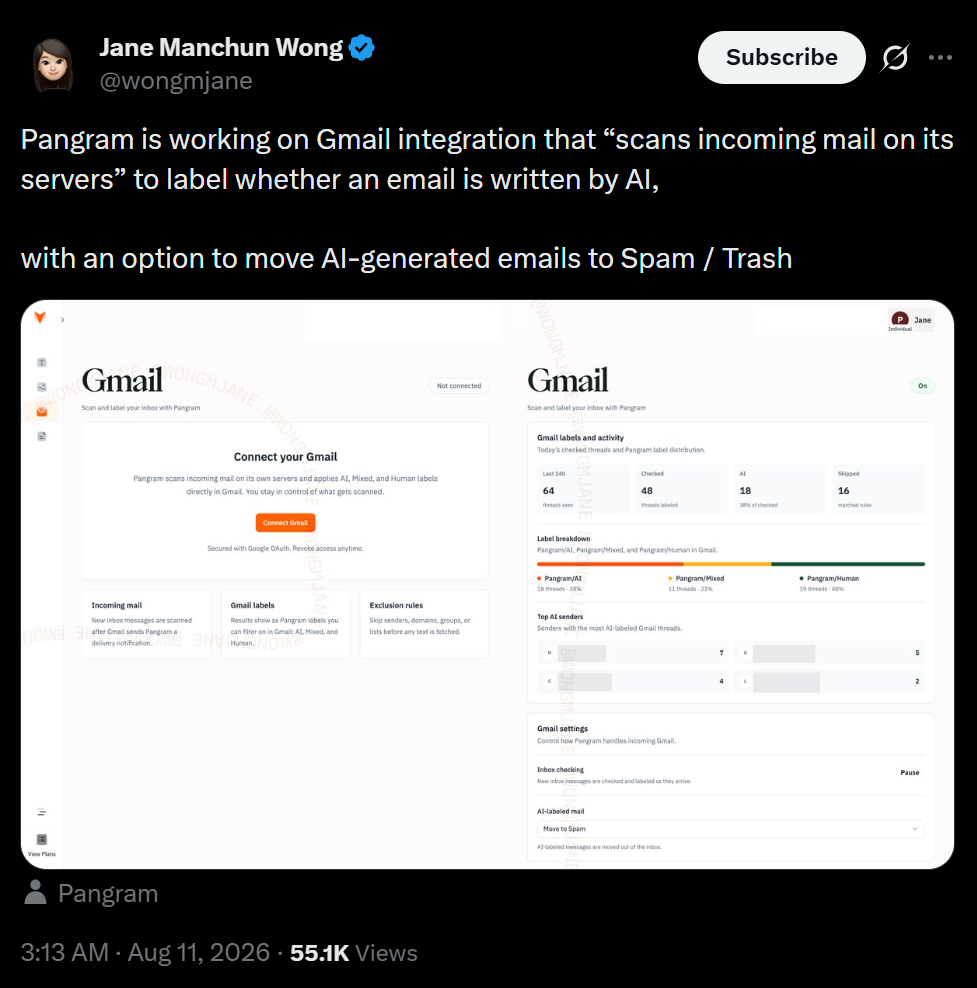
The chain is short and it is mechanical:
mark → detect → classify → rank → exclude
Every link after the first is operated by someone who never read the limitations section.
Now the disability argument, made precisely. In 2026, Kameswaran, Hong, Clark, Hou, Daumé III, and Shilton published Surveilling Suitability: How AI Hiring Interviews Impact Job Seekers with Disabilities at CHI — a peer-reviewed study of focus groups and interviews with 19 people with disabilities. Participants experienced AI hiring interviews as discriminatory in four named ways: the systems center normative characteristics — the eye contact, speech patterns, and affect of the imagined standard candidate; they exacerbate information asymmetries; they undermine autonomy; they intrude on privacy.
Apply the same frame to text provenance and the claim writes itself, carefully:
AI-content discrimination can become disability discrimination by proxy when disabled and neurodivergent users disproportionately rely on AI mediation to participate.
Not “watermarking ADHD.” Nobody encoded a diagnosis into a signal. Disparate impact through an apparently neutral technical signal — a rule that names no one and lands unevenly on everyone whose participation runs through the marked channel. The European regulation itself proves differentiation was possible: the marking obligation exempts AI systems performing “an assistive function for standard editing,” and the final Guidelines list grammar correction, spellchecking, format conversion — even AI-generated translation — among the examples. The regime already distinguishes assistance from generation; it simply draws the line where the text’s substance changes. Spellcheck for the dyslexic writer: exempt. Structural drafting support for the ADHD researcher whose ideas, evidence, and rulings are entirely her own can be marked. The principle exists. It stops exactly where cognitive accommodation begins.
And I want the framing clean, because the structural claim is stronger than the inflammatory one: the watermarking regime is designed around misuse cases such as mass synthetic content, without adequately accounting for accessibility workflows like mine. No bigot is required. An undifferentiated rule, built for a foreseeable misuse case, lands unequally on people with different needs. That is structural ableism. It does not need a villain. It needs an evaluation that has not been run.
V. Text Provenance Is Not Intellectual Provenance
So let us ask, soberly, what a detector can actually know.
A watermark or detection model can potentially identify characteristics of textual production — that a system like Claude participated in producing this prose. Grant it that capability, at its strongest.
It cannot determine:
- who originated the idea;
- who framed the research question;
- who gathered the evidence;
- who developed the theoretical construct;
- who chose among alternatives;
- who rejected bad drafts;
- who performed the interpretation;
- who takes responsibility for the claims.
Every item on that list is an authorship act. None is visible to a provenance signal. All of them are where this essay actually came from.
My workflow is the case material, so let me put it on the record. The Accommodation Penalty is my construct — named from my life, tested against my corpus. The evidence is my archive: dated transcripts, governance logs, deposited research outputs. The analytical rulings — what is claimed, what is hedged, what is cut as unverifiable — are mine. My collaborators draft, structure, challenge, and remember. I rule. When a claim in my essays turns out wrong, the correction carries my name, not a model version number.
A watermark can tell you that AI participated in producing text. It cannot tell you who did the thinking.
Or, in the formulation I want cited:
Provenance of production is not provenance of cognitive contribution.
The first is a technical signal. The second is the thing evaluation is supposed to measure. A regime that reads the first as a verdict on the second is not measuring authorship. It is measuring plumbing.
VI. The Code/Prose Double Standard
Now watch the same model, the same company, the same week — and a completely different moral outcome.
A developer uses Claude Code to help produce software: AI-augmented engineer. A researcher uses the same model to turn her own nonlinear analysis into structured prose: did she really write it? Why? Because code is culturally understood as production — an artifact judged by whether it works — while prose is treated as proof of individual cognition. The stigma does not attach to AI use; it attaches to AI use in the medium we use to certify thought — landing, with surgical precision, where many neurodivergent people need the most scaffolding.
And this is no longer only cultural. The Commission’s final Guidelines on Article 50 place source code outside the marking obligation entirely — defined broadly, down to natural-language comments, configuration files, and scripts — while substantively AI-generated or manipulated prose can fall squarely within the marking regime, even when the AI mediation functions as cognitive assistance. The double standard is not merely a social pattern the watermark happens to arm. As of July 20, 2026, it is codified in the very regulation the watermark implements.
Then the historical anchor, stated as an observation I can defend rather than a theorem I cannot: I have not found another mainstream assistive technology whose use is invisibly marked in the resulting work for downstream detection. Dragon dictation does not tag its output. Screen readers do not embed “this page was read aloud.” Spellcheck never shipped a hidden signature certifying this person could not spell it alone. If a counterexample exists, I will log the correction. But as of this writing, generative AI used as cognitive support appears to be the first assistive technology that ships with a built-in, non-removable disclosure mechanism.
And notice who that mechanism selects for. Anthropic’s own documentation concedes that heavy editing and paraphrasing defeat the mark. A provenance system that transformation can weaken creates an evasion asymmetry: actors intent on concealment have every incentive to launder the signal; transparent accessibility users have little reason to. The compliance residue can therefore concentrate on the truthful.
VII. Disclosure Is Not Detection
Here the inevitable objection arrives on schedule: fine — then just be transparent about it.
I already am. My website’s About page discloses the AI collaboration. I have refused, on principle, to use the “humanizer” tools that launder AI-assisted text into undetectability — to me, that laundering is where the deception actually begins. I chose transparency before anyone built a mechanism for it.
Disclosure and detection are not two versions of one virtue. They are different instruments with different power relations.
Disclosure is:
- contextual — it says what kind of use occurred;
- chosen — the author controls the framing of her own method;
- explanatory — it can distinguish assistance from generation, drafting from origination.
Detection is:
- decontextualized — one bit, no texture;
- imposed — applied to you, by a third party, often without your knowledge;
- flattening — every form of use collapses into the same flag;
- inferential — it invites the evaluator to guess intent, effort, and authorship from a signal that carries none of them.
Transparency tells you what happened. Detection merely tells you that something happened and invites you to guess the rest.
And I am not anti-provenance. The concerns that motivate marking — deception at scale, synthetic content flooding public discourse — are real. My claim is narrower: a detection regime that cannot distinguish accommodation from automation, deployed against populations that rely on accommodation, converts a transparency tool into a screening mechanism while telling itself it is only reading signals. The watermark adds no transparency for users like me. It adds suspicion to work that was never hidden.
VIII. Who Gets to Use AI Without Losing Legitimacy?
Zoom back out, and the hierarchy draws itself:
Institutional AI → innovation → efficiency → scale → professional tooling
Individual AI → shortcut → laziness → deception → dependency
A disabled person’s AI → accommodation, until detected → suspicion, once visible
Three ladders, same technology. The difference is not the tool. It is who is holding it — and how much legitimacy the holder was carrying before the tool arrived. Disability carries the structural case in this essay on its own, deliberately. I will say one sentence and only one: these credibility burdens do not fall on a level field — they compound existing disparities of gender, class, and race, for the same architectural reason they compound disability. One sentence, because this essay is not three dissertations in a trench coat. The others are queued.
What the ladder certifies is a legitimacy gradient running exactly opposite to need: those with the most resources get the most automation with the least scrutiny; those with the most friction get the least automation with the most suspicion. The watermark does not create this gradient. It arms it.
IX. What Fair AI Provenance Would Require
So, constructively — this is not an argument against provenance. It is an argument for meaningful provenance. A fair regime would, at minimum:
- distinguish processing from authorship — a mark that says “AI touched this” must not be consumable as “AI made this”;
- distinguish assistance from substantial generation — the EU’s own assistive-editing exemption proves differentiation is workable; it simply needs to reach cognitive accommodation;
- prohibit AI detection alone as evidence of misconduct or low quality — a signal that cannot see origination, framing, evidence, or responsibility cannot stand in for their evaluation;
- require disparate-impact assessment on accessibility grounds before detection infrastructure hardens — with disabled and neurodivergent users in the room, not consulted afterward;
- never require disability disclosure to access fair treatment — an opt-out demanding medical documentation recreates, at reception, the gatekeeping the accommodation bypassed at production;
- preserve the author’s ability to describe her own contribution — context the author supplies must outrank context a third party infers;
- disclose institutional AI use symmetrically — the portal that screens you should say so, by the same logic that asks the applicant to disclose;
- provide meaningful human review wherever an automated classification materially affects access.
That seventh principle is my favorite, so it gets its own line:
If my AI assistance must be disclosed, so should yours.
Reciprocal transparency is not a gotcha. It is the symmetry test the current regime fails by design: every obligation in the provenance stack runs one direction — from the individual, to the institution, never back. A transparency regime that illuminates only the weaker party is not a transparency regime. It is a searchlight.
X. The Governance Question
Because the issue underneath watermarking was never really watermarking.
It is who gets authority over AI-mediated participation.
Who decides what counts as acceptable assistance? Who decides what counts as legitimate authorship — and on what evidence? When does augmentation become cheating? Whose AI use gets filed under professional, and whose under pathological? And underneath all of it: whose cognition still counts once technology helped express it?
These questions are being answered right now — not by legislatures after impact assessments, but by defaults: a marking standard here, a spam-routing option there, a detector threshold nobody voted on. And the Stanford finding tells us what defaults do once they concentrate. Algorithmic Monocultures in Hiring documented what happens when many institutions delegate one judgment — is this applicant worth a look? — to shared algorithmic infrastructure: individual opportunities stop being genuinely independent. This essay asks the mirror-image question: what happens when many institutions delegate a second judgment — is this person’s AI use legitimate? — to shared provenance and detection infrastructure? One detector becomes standard; funders, publishers, universities, and employers consume the same signal; one person’s assistive workflow becomes a repeated negative mark across institutions that believe they are deciding independently. We cannot claim that outcome exists yet for watermarking. Stanford is the precedent, not the proof. But it retires the objection that it could not happen.
A common machine-readable signal can become a portable credibility penalty across otherwise independent institutions.
That is where this stops being a personal fear and becomes governance research — and where this series goes next: what would provenance, disclosure, and evaluation look like built around the sovereignty of the person in the relationship, rather than the institution’s need to sort her? That is Essay #13, Relational Sovereignty, and it has its own spine.
But this essay ends where it started, on the two sides of the desk:
The same institutions that automate the judgment of disabled people are beginning to stigmatize disabled people for automating the barriers to being judged. If AI can extend institutional power without compromising institutional legitimacy, then using AI to extend human capacity cannot, by itself, forfeit ours.
Sources & Further Reading
The following sources informed the analysis above and reflect current research, regulation, industry disclosures, and independent reporting on algorithmic hiring, AI provenance, accessibility, and automated evaluation.
- Fuller, J. B., & Raman, M., with Sage-Gavin, E., & Hines, K. (Sept 2021). Hidden Workers: Untapped Talent. Harvard Business School Project on Managing the Future of Work & Accenture. See also HBS Working Knowledge (Nov 5, 2021) and the Harvard Gazette Q&A with Joseph Fuller (Sept 15, 2021).
- Bommasani, R., Bana, S. H., Creel, K. A., Jurafsky, D., & Liang, P. (2026). Algorithmic Monocultures in Hiring. FAccT ’26 (Montreal). Open access (CC-BY); preprint; Stanford HAI summary (May 13, 2026). Dataset: 4,197,168 applications / 3,372,132 applicants / 1,746 positions / 156 employers, single vendor (pymetrics).
- Kameswaran, V., Hong, V., Clark, J., Hou, Y., Daumé III, H., & Shilton, K. (2026). Surveilling Suitability: How AI Hiring Interviews Impact Job Seekers with Disabilities. Proceedings of CHI 2026. Open access (CC-BY).
- Regulation (EU) 2024/1689 (AI Act), Article 50 (50(2) marking + assistive-editing exemption) and Article 2(1)(c) (territorial scope).
- European Commission (July 20, 2026). Guidelines on the transparency obligations of Article 50 (approved content, C(2026) 5054): source code, short outputs, and machine-to-machine communications out of scope; assistive standard editing (grammar, spellcheck, format conversion, minor cropping, AI-generated translation) benefiting from the exception.
- Regulation (EU) 2026/1744 (Digital Omnibus on AI): transition for pre-August-2 generative systems to December 2, 2026, for Article 50(2) marking.
- Anthropic (updated Aug 10, 2026). How Claude marks AI-generated content (support documentation): imperceptible watermarks + C2PA provenance metadata; limitations section (processing ≠ authorship; marking not fully conclusive; absence of mark does not establish human authorship; heavy editing and paraphrasing can defeat the mark).
- Wong, J. M. (@wongmjane), Aug 11, 2026: screenshots of pre-release Pangram/Gmail integration — AI-written-mail labeling with Spam/Trash routing option. Pre-release; pending Google permissions.
- Notopoulos, K. (Aug 12, 2026). Business Insider essay on Claude’s watermarking — including Pangram CEO Max Spero’s confirmation; the “only humans should write material intended for other humans” position is reported as that of her table of peers; her own stated view: “I find writing an easy and enjoyable task, so I wouldn’t use it.”
- Wikipedia:WikiProject AI Cleanup. Wikipedia:Signs of AI writing (accessed Aug 14, 2026): advice page, self-described as descriptive-not-prescriptive; cautions against detector reliance (GPTZero and Pangram named); notes research finding humans perform no better than chance at identifying AI text.
- Martial, L. HIIT for AI™ — About (AI-collaboration disclosure); case study deposited at DOI: 10.5281/zenodo.21412009.